Artificial intelligence · Data protection
Private ChatGPT for business: how to build a secure internal assistant
A private ChatGPT for business (more precisely, a private AI assistant) answers using only your organization's internal information: documents, history, client data. It is not OpenAI's ChatGPT running in private; it is your own assistant, with defined sources, role-based permissions, a log of every query and assurances that your data does not train third-party models.

Written by Lluís Casals Marsol · Founder at Camacode
Published on
Being able to ask an AI “what do we know about this client?” can save an enormous amount of time. But when we are talking about clients, patients, case files or sensitive information, pasting data into the public ChatGPT is not enough. The challenge is not only that the AI answers well: it is that it does so securely, under control and within the context of your company.
What is a private ChatGPT for business?
It is an internal assistant that works like a ChatGPT for your company: the team asks in natural language and it answers by querying documentation, client data, history, internal processes or operational information. What sets it apart from the public tool is control: you decide which sources it queries, who can ask it what, where the data is processed and what gets logged. It can be deployed on cloud services with contractual guarantees or on your own infrastructure, depending on how sensitive the information is. It is one of the projects we develop as an AI agency: useful only if it knows the company well, and viable only if that knowledge is properly governed.
”Private ChatGPT” is what people call it. The accurate term is private AI
It is worth being precise here, because the wording matters when you go looking for a provider. ChatGPT is OpenAI’s product, and there is no private edition of it that you install and own. What you actually build is a private AI assistant: your own application, connected to your own sources, running on whichever model you choose, whether OpenAI’s, Anthropic’s or an open-weights model on your own server. “Private ChatGPT” caught on because ChatGPT is the reference everyone shares, and it does describe the experience well. But when a vendor sells you “a private ChatGPT” without ever explaining which model runs underneath, where it runs and who can see the data, that is the moment to start asking questions.
Why isn’t the public ChatGPT enough?
Pasting client data into a public tool raises four problems. Legal: the free version of ChatGPT offers no data processing agreement and, by default, uses conversations to train its models; feeding it personal data about your clients (invoices, emails, case files) is in practice a GDPR breach, with fines of up to 4% of turnover. Control: the information leaves your environment for a service you do not manage. Context: a generic ChatGPT does not know your processes or your history, so it forces you to paste sensitive information into every query. Governance: there are no permissions, no record of who consulted what, and no way to audit misuse. And the usual reality is that the team is already doing it on their own: the realistic alternative to banning it is offering a secure internal channel.
How do you design a private ChatGPT, in the cloud or self hosted?
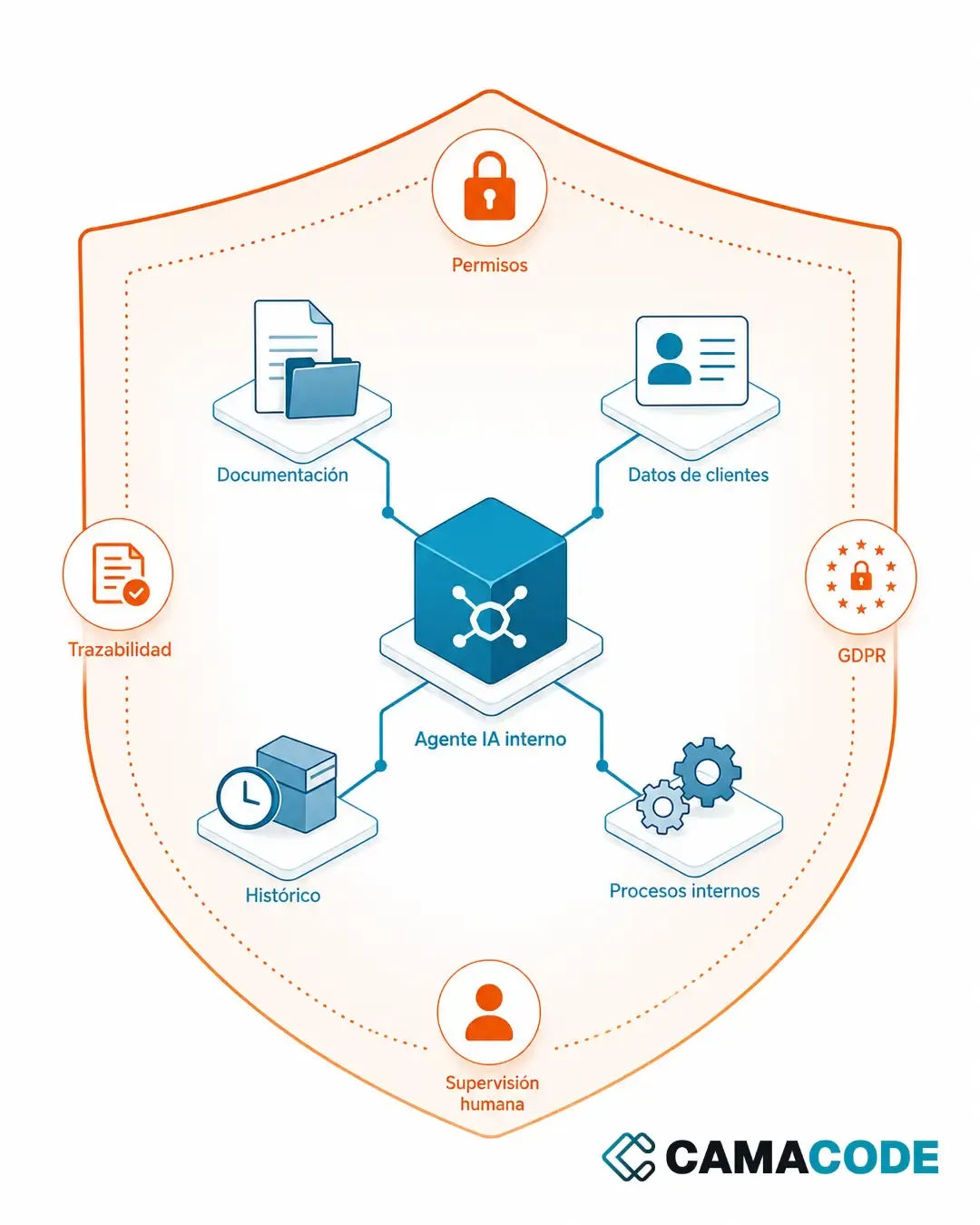
Controlled data sources
The assistant answers only from defined sources: the repositories, databases and documents you decide to connect. That limits what it can know, keeps the information up to date and reduces made-up answers: when the answer is not in the sources, the assistant is instructed to say it does not know rather than fill the gap. Reduces, not eliminates (even with its sources in front of it, a model can still get an answer wrong), which is exactly why the design keeps human review on the delicate cases.
Permissions by user or role
A private ChatGPT should not answer everyone the same way. Management, admin, customer service and operations do not need to see the same information. The right question is not “can we connect the AI to our data?” but “what can each person query, in what context and within what limits?”. The assistant inherits the permissions of the user asking: if you cannot open that case file, the AI will not summarize it for you either.
Cloud with guarantees or self hosted AI for business
Not all cloud AI is the same. Services such as Azure OpenAI or Amazon Bedrock are built for companies: they sign data processing agreements, commit to not using your data to train their models and allow processing in European regions. Most projects run perfectly well on that footing: the power of the large models with the data-protection guarantees the public tool does not offer. And when the data is especially sensitive (health records, legal case files, strategic information), the next step is fully private AI: open-weights models running on your own infrastructure, connected to your database and, where needed, tuned with it, so that nothing ever leaves your premises. It becomes just another system you run in-house. It costs more and demands maintenance, so it is decided case by case; we explain this option on our local AI server page.
Traceability and human oversight
Every query and every answer is logged: who asked, which sources were used, what was answered. That log makes it possible to audit usage and catch problems early. And for delicate cases (patient information, decisions that affect people) human review is built in: the AI prepares, a person validates. The goal is not an AI that sees everything, but one that helps each team with the right information.
AI and GDPR compliance: what does a private ChatGPT need?
If the assistant queries personal data, data protection is part of the design, not a final formality. In practice that means: minimizing the data it can access (only what each use actually needs), having a lawful basis for that processing, signing data processing agreements with the providers involved, controlling where the data is processed (paying attention to transfers outside the EU), and being able to honor rights such as access or erasure in the sources feeding the AI as well. No serious provider promises “automatic GDPR compliance”: compliance depends on how the system is designed and used in your specific case. At Camacode we work on that design alongside your legal advisers; we explain how on the AI and GDPR compliance page.
Case study: an internal assistant with exactly the right information for each role
An anonymized example of the pattern: a services company with years of case files wanted its team to stop digging through folders and simply ask “what did we agree with this client?”. The design mattered as much as the technology: the assistant queries only the approved repository, customer service sees the history of their own accounts but not financial data, management sees everything, and every query is logged. The same information as always, accessible in seconds and without losing control. If your starting point is unstructured documents, begin by turning them into data. And if you want the general method for choosing your first use case, we set it out in how to implement AI in my business.
Where do you start with a private ChatGPT for business?
Do not start with the model or the provider: start with three lists. First, which information would genuinely be worth querying in natural language: contracts, client history, procedures, case files. Second, who needs it, and for which specific decision. Third, the one most people skip: what should never be accessible, and to whom. With those three lists on the table, the rest of the decisions become easy: whether a cloud service with a data processing agreement is enough or you need your own infrastructure, and which permissions each role inherits. Then pick a contained pilot (one source, one team, one question that today gets answered by digging through folders) and measure whether it actually saves time. If it works, you widen it; if it does not, you have lost a few weeks rather than a whole project.
Which internal data would make sense to query with a private ChatGPT in your company, and within what limits? Tell us what you would want it to answer and we will define the sources, the permissions and the first use case together.